Of Beauty & Deities: Music & Dance of India
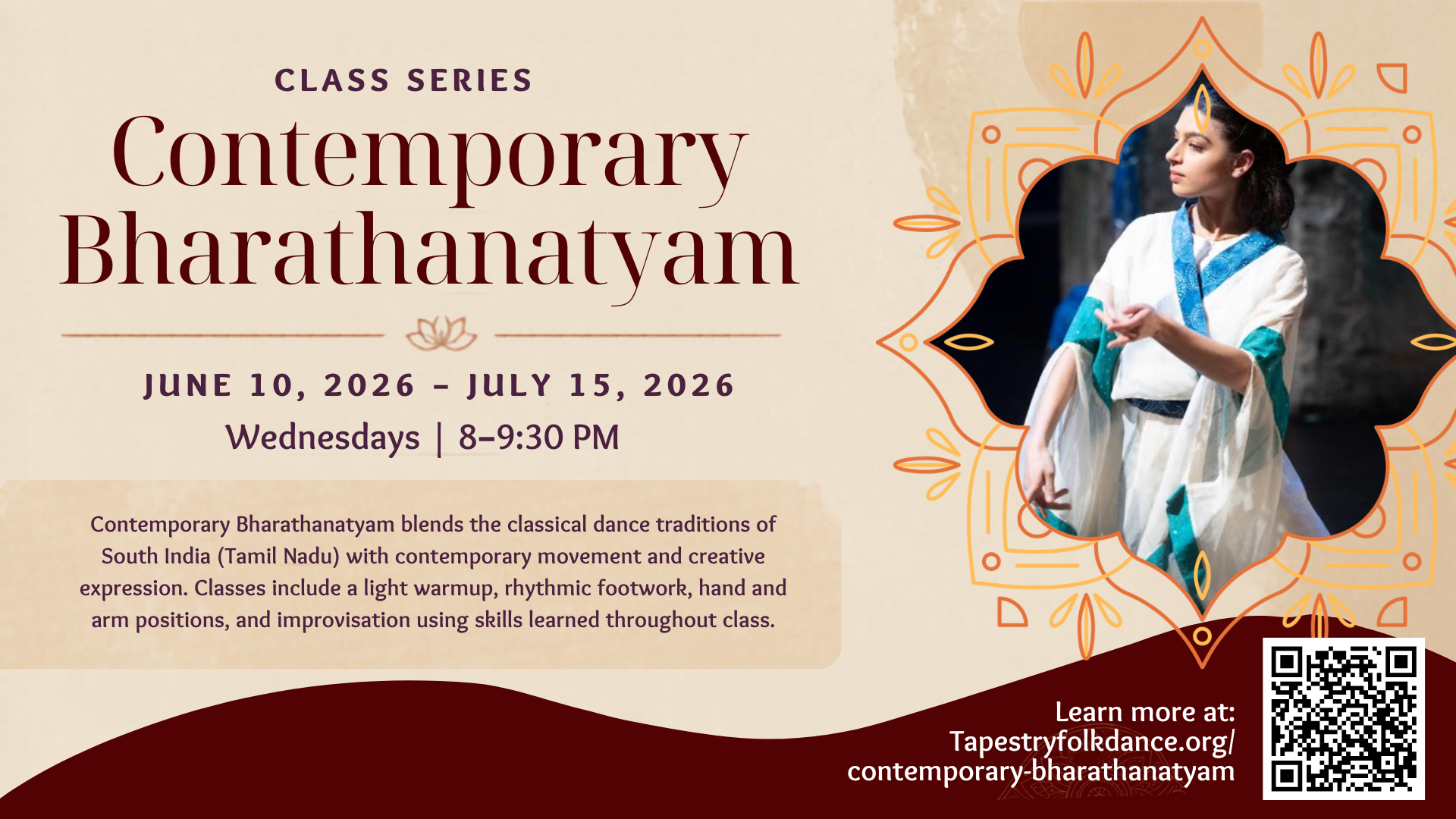
Hello Tapestry Community! I’ve been missing school and writing a bit lately and have found myself exploring the Dance in Video collection, an amazing online offer by the Hennepin County Library. I’d like to start dropping in periodically with my reviews of publicly accessible books, films, and other resources relevant to Tapestry’s mission. If you have any recommendations to keep me going please send them over to operationsmanager@tapestryfolkdance.org. For our first month I’d like to tie my review in with our June and July Tapestry Class Series offering of Contemporary Bharathanatyam!
In graduate school, I studied under Dr. Avanthi Meduri, a dance scholar and playwright trained in Kuchipudi and Bharatanatyam. Dr. Meduri was instrumental in bringing the academic study of South Asian dance to the United Kingdom, where I attended school, and she remains a prolific and influential scholar in the field. My own dance training focused primarily on classical concert forms, but it was also deeply Eurocentric, and I was not introduced to Bharatanatyam until I became one of her students. In class, we often discussed the form through political and cultural lenses such as gender, colonialism, and globalization. I remain fascinated by both the theatricality of Bharatanatyam and its extraordinary storytelling power.
This month for Common Threads, I watched Of Beauty & Deities: Music & Dance of India. Early in the documentary, music and dance are described as “a way of expressing our deepest thoughts and feelings,” a sentiment that feels especially resonant here at Tapestry.
While most of the dances featured in the documentary are hundreds of years old, the opening piece, Dance to Mother Earth, is a contemporary choreography. As the film shows a solo dancer performing precise, rhythmically intricate footwork and expressive hand gestures alongside live musicians, it introduces foundational principles of Indian culture and dance. The documentary explains, for example, that dancing barefoot is an act of respect toward the deities for whom the dances are performed, and that the dances themselves function as a form of sign language.
Throughout the film, K.P. and Katherine Kunhiraman, directors of Kalanjali Dances of India, are interviewed alongside dancers, vocalists, and musicians from their company. Together, they discuss their artistic lineages and the role of music and dance within Hindu traditions. They explain that Bharatanatyam is an ancient art form rooted in the Natya Shastra, a foundational classical text on music, dance, and drama. The documentary notes that the form incorporates at least fifty codified hand gestures, or mudras, as well as nine primary facial expressions, known as navarasas, which combine to create intricate systems of storytelling. The music follows similarly structured principles laid out in the Natya Shastra, built from ragas (melodic frameworks) and talas (rhythmic cycles). Vocals are described as “leading the show,” while instrumental accompaniment blends composed phrases with improvisational passages shaped by the needs of the performance. The film also emphasizes the importance of costume design to both the visual and narrative dimensions of the form.
One aspect of the documentary I especially appreciated was the attention given to the musicians themselves. Throughout the film, performers introduce their instruments individually and demonstrate isolated musical passages, allowing viewers to hear and better understand each instrument’s distinct voice within the ensemble.
The next dance featured is the Tillana. Traditionally choreographed as a solo work within the Bharatanatyam repertoire, it is presented here with nine dancers filling the stage. The film explains that expanding these dances for larger ensembles began as an “American compromise” for performance contexts in the United States, though the practice has since become common in India as well.
The documentary then transitions to the Kirtanam, presented with subtitles. As someone with a limited background, I found this extremely helpful. Being able to follow the narrative text while watching the dancers made the storytelling elements far more accessible and deepened my appreciation for the expressive precision of the performance. The final dance shown is a folk dance from Orissa. Unlike the earlier ensemble pieces, which followed highly codified choreography, this dance felt more participatory and communal, incorporating partnered transitions and circular formations that created a different energy on stage.
Beyond the performances themselves, I was especially interested in the documentary’s discussions of Indian immigration to the United States, the occupations commonly pursued by Indian immigrants, and the expansive role religion plays in shaping cultural traditions in India. I was also fascinated to learn that temples once kept hundreds of dancers on payroll at a time. The film briefly references how these dance traditions were endangered under British colonial rule, when temple dancing was outlawed, and I hope to continue researching the conscious preservation efforts that emerged after Indian independence to revitalize the form.
Overall, Of Beauty & Deities is both informative and approachable, balancing historical and cultural context with an emphasis on simply experiencing the dances themselves. I thoroughly enjoyed it and am excited to participate in next month’s Tapestry Class Series to continue exploring what I learned from the film.
Of Beauty & Deities: Music & Dance of India, directed by Eve A. Ma, 1943-; presented by Eve A. Ma, 1943-; produced by Eve A. Ma, 1943-, Palomino Productions; performed by Kalanjali: Dances Of India (Berkeley, CA: Palomino Productions, 2010), 57 mins